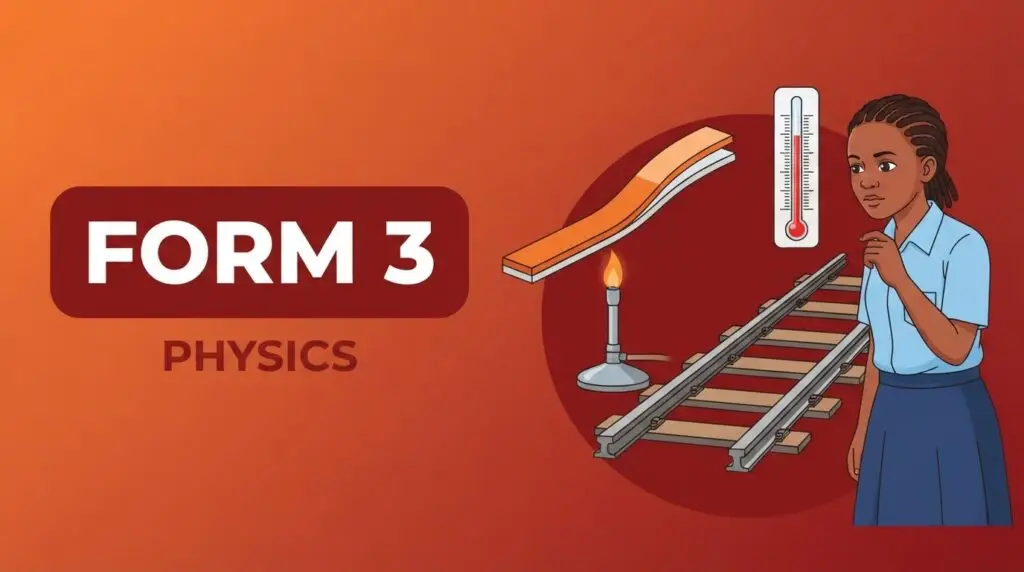
Have you ever noticed small gaps between railway lines or between sections of a bridge? Those gaps exist because of thermal expansion. These Form Three Physics thermal expansion notes explain how solids, liquids and gases change size when heated, how to calculate linear expansivity, and where expansion is useful or troublesome in daily life. Work through the examples and answer the review questions at the end.
Contents
What Is Thermal Expansion?
Thermal expansion is the increase in the size (length, area or volume) of a substance when its temperature rises. The opposite effect, a decrease in size on cooling, is called contraction.
The kinetic theory of matter explains this. When a substance is heated, its particles gain kinetic energy and vibrate or move more vigorously. They push each other further apart, so the average distance between particles increases and the substance occupies more space. The mass stays the same, so the density decreases.
For the same rise in temperature, gases expand the most, liquids expand less, and solids expand the least. This is because the forces between particles are weakest in gases and strongest in solids.
Expansion of Solids
Demonstrating Expansion of Solids
Ball and ring experiment: a metal ball just passes through a metal ring at room temperature. After the ball is heated strongly with a Bunsen burner, it no longer passes through the ring. When it cools, it passes through again. This shows that solids expand on heating and contract on cooling.
Bar breaker experiment: a heated iron bar is tightened in a strong frame and held by a cast-iron pin. As the bar cools and contracts, it pulls with such great force that the pin snaps. This shows that the forces produced by expansion and contraction are very large.
Linear Expansivity
Different solids expand by different amounts. The linear expansivity (coefficient of linear expansion), α, of a material is the increase in length per unit original length per degree rise in temperature.
α = (L₂ − L₁) ÷ (L₁ × Δθ), where L₁ is the original length, L₂ the final length and Δθ the temperature change. The unit is per kelvin (K⁻¹) or per degree Celsius (°C⁻¹), which have the same size.
Rearranging gives the expansion: ΔL = α × L₁ × Δθ. Approximate values: aluminium 2.3 × 10⁻⁵ K⁻¹, copper 1.7 × 10⁻⁵ K⁻¹, steel 1.2 × 10⁻⁵ K⁻¹ and ordinary glass about 0.9 × 10⁻⁵ K⁻¹. Invar, a nickel–steel alloy, expands very little, so it is used in measuring tapes and clock pendulums.
Solids also expand in area and volume. The area (superficial) expansivity β is approximately 2α, and the volume (cubic) expansivity γ is approximately 3α.
Worked Examples
Example 1: A steel rail is 20 m long at 20 °C. By how much does it expand when its temperature rises to 45 °C? (α for steel = 1.2 × 10⁻⁵ K⁻¹)
ΔL = α × L₁ × Δθ = 1.2 × 10⁻⁵ × 20 × 25 = 0.006 m = 6 mm. A gap of at least 6 mm must be left between rails.
Example 2: A copper rod 2.000 m long at 25 °C becomes 2.0034 m long at 125 °C. Find its linear expansivity.
α = (2.0034 − 2.000) ÷ (2.000 × 100) = 0.0034 ÷ 200 = 1.7 × 10⁻⁵ K⁻¹.
Applications of Thermal Expansion in Daily Life
The Bimetallic Strip
A bimetallic strip is made of two different metals, such as brass and iron, riveted together along their length. When heated, brass expands more than iron, so the strip bends with brass on the outside (convex side). On cooling below the starting temperature, it bends the other way.
Uses of the bimetallic strip include thermostats in electric irons, ovens and water heaters (the strip bends to break the circuit when the set temperature is reached), fire alarms (the strip bends to close a circuit and ring a bell), flashing indicator lights, and dial thermometers.
Other Useful Applications
- Riveting: hot rivets join metal plates; as they cool they contract and pull the plates tightly together.
- Fitting steel tyres on wheels: the tyre is heated so it expands and slips over the wheel, then shrinks to a tight fit.
- Loosening a tight lid: pouring hot water over a metal lid makes it expand more than the glass jar, so it opens easily.
- Liquid-in-glass thermometers: mercury or alcohol expands up the capillary tube as temperature rises.
Problems Caused by Expansion and Their Solutions
- Railway lines are laid with small gaps so they do not buckle on hot days.
- One end of a steel bridge rests on rollers so the bridge can expand and contract freely.
- Overhead power and telephone cables are left slightly loose so they do not snap when they contract on cold nights.
- Thick glass cracks when hot water is poured into it because the inside expands faster than the outside; heat-resistant (Pyrex) glass has a very low expansivity.
- Long pipes carrying steam have expansion loops that allow them to change length safely.
Expansion of Liquids and Gases
Real and Apparent Expansion of Liquids
When a flask full of coloured water is heated, the liquid level first drops slightly and then rises. The drop happens because the glass flask is heated first and expands before the heat reaches the liquid. The rise that we observe is the apparent expansion. The real expansion of the liquid equals the apparent expansion plus the expansion of the container.
Anomalous Expansion of Water
Most liquids expand steadily when heated, but water behaves unusually between 0 °C and 4 °C. When water is heated from 0 °C to 4 °C, it contracts; above 4 °C it expands like other liquids. Therefore water has its smallest volume and maximum density at 4 °C.
This matters in nature. In cold countries, lakes freeze from the top downwards. Water at 4 °C, being densest, sinks to the bottom, and the ice that forms on top floats and insulates the water below, so fish survive. It also explains why water pipes burst in freezing weather: water expands when it turns into ice.
Expansion of Gases
Gases expand far more than solids and liquids for the same rise in temperature. Place a flask fitted with a delivery tube upside down so the tube dips into water, then warm the flask with your hands. Bubbles of air escape from the tube, showing that even a small temperature rise makes air expand noticeably. When the flask cools, water rises up the tube.
Summary Table
| Concept | Key point |
|---|---|
| Thermal expansion | Increase in size of a substance on heating |
| Order of expansion | Gases > liquids > solids |
| Linear expansivity | α = ΔL ÷ (L₁ × Δθ), unit K⁻¹ |
| Area and volume expansivity | β ≈ 2α, γ ≈ 3α |
| Bimetallic strip | Bends towards the metal that expands less |
| Anomalous expansion | Water contracts from 0 °C to 4 °C; densest at 4 °C |
For the remaining Form Three topics, see our Form Three Physics Notes All Topics, and practise calculations with the Form Three Physics Current Electricity questions and answers.
Review Questions with Answers
- Why do solids expand when heated? Answer: Their particles gain kinetic energy, vibrate more and move further apart, increasing the size of the solid.
- An aluminium rod 1.5 m long is heated from 20 °C to 120 °C. Find its increase in length (α = 2.3 × 10⁻⁵ K⁻¹). Answer: ΔL = 2.3 × 10⁻⁵ × 1.5 × 100 = 0.00345 m = 3.45 mm.
- A brass–iron bimetallic strip is heated. Which metal is on the outside of the curve? Answer: Brass, because it expands more than iron.
- At what temperature is water densest? Answer: At 4 °C.
- Give two ways engineers allow for expansion in structures. Answer: Leaving gaps between railway lines and placing one end of a bridge on rollers (also accept loose power cables or expansion loops in pipes).
Frequently Asked Questions
What is the SI unit of linear expansivity?
Per kelvin (K⁻¹). Per degree Celsius (°C⁻¹) gives the same numerical value because a change of 1 °C equals a change of 1 K.
Why is invar used in measuring tapes?
Invar has a very low linear expansivity, so its length hardly changes with temperature and measurements stay accurate.
Why does a glass flask’s water level drop first when heated?
The glass is heated first and expands, increasing the volume of the flask before the water warms up and expands.
Final Word
Thermal expansion links theory with everyday things you see around you, from railway lines to electric irons. Learn the formula for linear expansivity, practise the calculations, and be ready to explain the bimetallic strip and the anomalous expansion of water in clear sentences. Keep revising this holiday so you enter Form Four confident.