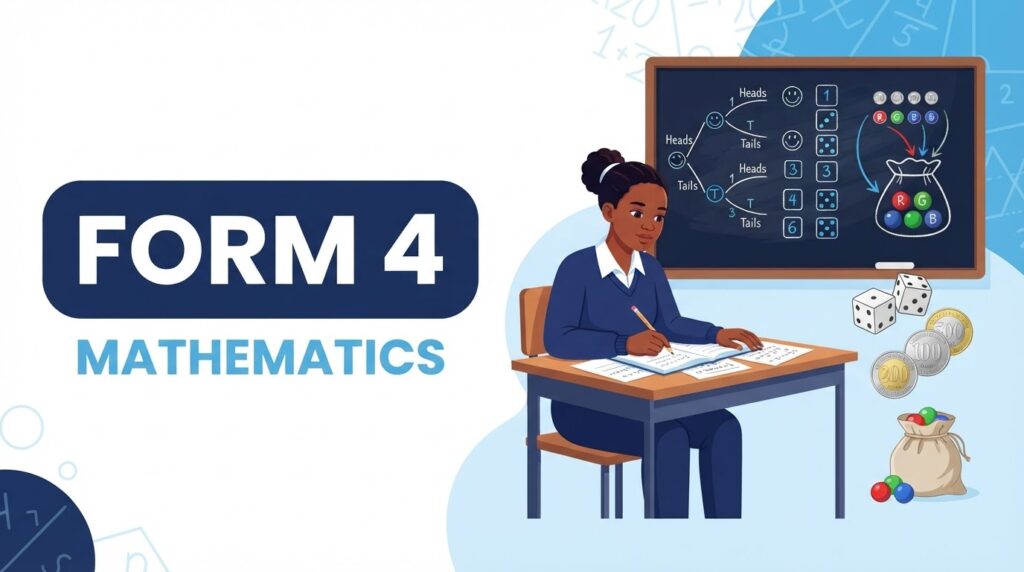
Probability is one of the most scoring topics in Form Four Basic Mathematics because the methods are short and logical once you understand them. This revision guide gives you a quick summary of key ideas followed by original Form Four probability questions with fully worked answers, common mistakes to avoid and study tips. Whether you are entering Form Four in January or preparing early for CSEE, practise every question before reading the solution.
Contents
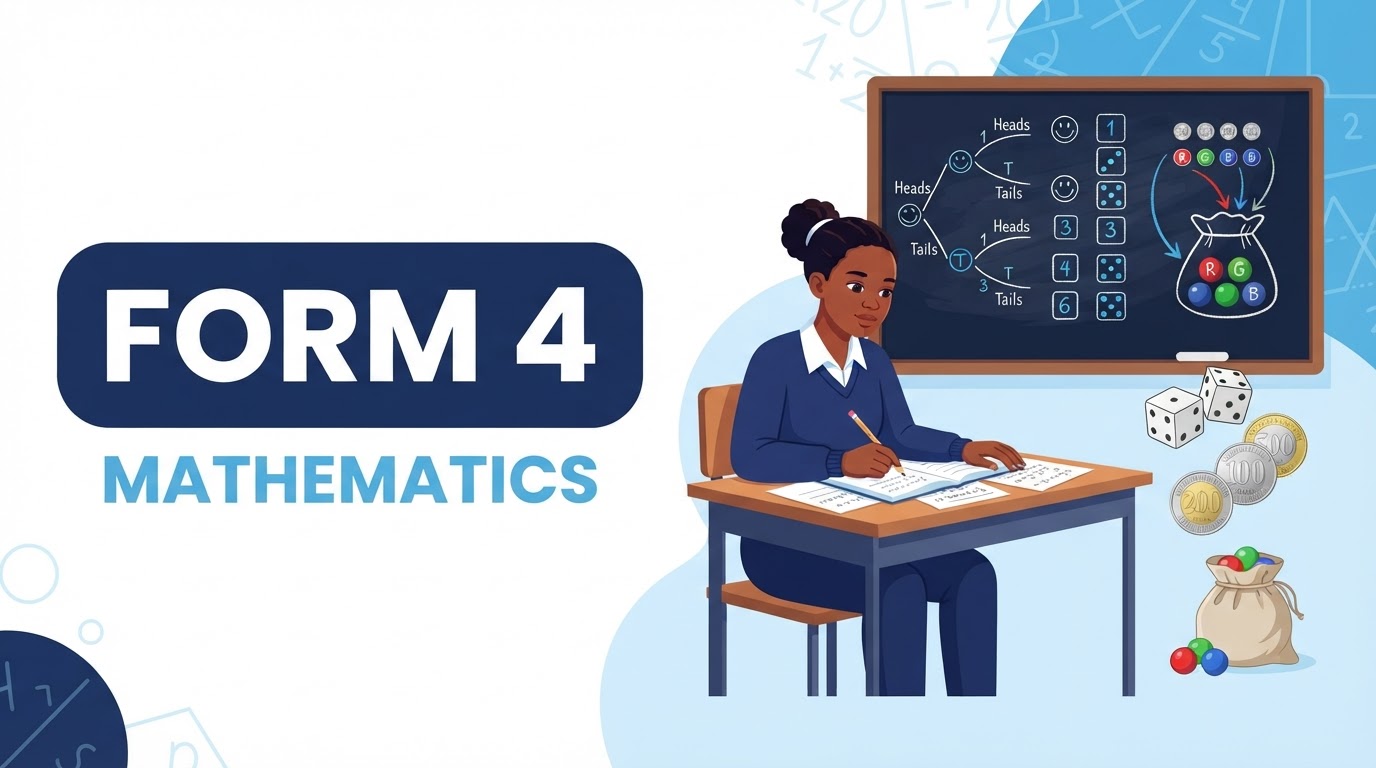
Key Ideas in Probability
- Experiment: an activity with uncertain results, such as tossing a coin or throwing a die.
- Sample space (S): the set of all possible outcomes. For one die, S = {1, 2, 3, 4, 5, 6}.
- Event (E): a subset of the sample space, for example “getting an even number”.
- Probability of an event: P(E) = n(E) ÷ n(S), when all outcomes are equally likely. Always 0 ≤ P(E) ≤ 1.
- Complementary events: P(not E) = 1 − P(E).
- Mutually exclusive events cannot happen together: P(A or B) = P(A) + P(B).
- Events that overlap: P(A or B) = P(A) + P(B) − P(A and B).
- Independent events do not affect each other: P(A and B) = P(A) × P(B).
- Tree diagrams organise combined events: multiply along branches, add between final outcomes.
To review the rest of the syllabus, see our Form Four Mathematics Notes All Topics.
Form Four Probability Questions with Worked Answers
Single Events
Question 1: A fair die is thrown once. Find the probability of getting a prime number.
Answer: S = {1, 2, 3, 4, 5, 6}, so n(S) = 6. Prime numbers are 2, 3 and 5, so n(E) = 3. P(prime) = 3/6 = 1/2. (Remember that 1 is not a prime number.)
Question 2: A bag contains 5 red, 3 blue and 2 green balls. One ball is picked at random. Find the probability that it is not blue.
Answer: Total = 10 balls. P(blue) = 3/10, so P(not blue) = 1 − 3/10 = 7/10.
Question 3: Cards numbered 1 to 20 are shuffled and one card is drawn. Find the probability that the number is a multiple of 3 or a multiple of 5.
Answer: Multiples of 3: 3, 6, 9, 12, 15, 18 (6 cards). Multiples of 5: 5, 10, 15, 20 (4 cards). The number 15 is in both lists. n(E) = 6 + 4 − 1 = 9. P = 9/20.
Question 4: In a class of 40 students, 25 study Physics, 20 study Chemistry and 10 study both. A student is chosen at random. Find the probability that the student studies neither subject.
Answer: Students studying at least one subject = 25 + 20 − 10 = 35. Neither = 40 − 35 = 5. P(neither) = 5/40 = 1/8.
Combined Events with Coins and Dice
Question 5: Two fair coins are tossed together. List the sample space and find the probability of getting at least one head.
Answer: S = {HH, HT, TH, TT}. Outcomes with at least one head: HH, HT, TH = 3. P = 3/4. Alternatively, P(at least one head) = 1 − P(TT) = 1 − 1/4 = 3/4.
Question 6: Two fair dice are thrown. Find the probability that the sum of the scores is 8.
Answer: n(S) = 6 × 6 = 36. Pairs giving 8: (2,6), (3,5), (4,4), (5,3), (6,2) = 5 outcomes. P = 5/36.
Question 7: Two fair dice are thrown. Find the probability that the sum is 7 or 11.
Answer: Sum 7: (1,6), (2,5), (3,4), (4,3), (5,2), (6,1) = 6 outcomes. Sum 11: (5,6), (6,5) = 2 outcomes. These events are mutually exclusive, so P = (6 + 2)/36 = 8/36 = 2/9.
Question 8: A fair die is thrown twice. Find the probability of getting at least one six.
Answer: P(no six in one throw) = 5/6. P(no six in two throws) = 5/6 × 5/6 = 25/36. P(at least one six) = 1 − 25/36 = 11/36.
Independent Events and Tree Diagrams
Question 9: The probability that Amani passes a test is 0.8 and the probability that Neema passes is 0.6. Their results are independent. Find the probability that (a) both pass (b) neither passes (c) exactly one passes.
Answer: (a) 0.8 × 0.6 = 0.48. (b) P(Amani fails) = 0.2 and P(Neema fails) = 0.4, so 0.2 × 0.4 = 0.08. (c) (0.8 × 0.4) + (0.2 × 0.6) = 0.32 + 0.12 = 0.44. Check: 0.48 + 0.08 + 0.44 = 1.
Question 10: A box contains 4 red and 6 white pens. Two pens are picked one after the other without replacement. Find the probability that (a) both are red (b) one is red and one is white (c) both are white.
Answer: Draw a tree diagram. For the second pick there are only 9 pens left.
(a) 4/10 × 3/9 = 12/90 = 2/15.
(b) Red then white: 4/10 × 6/9 = 24/90; white then red: 6/10 × 4/9 = 24/90. Total = 48/90 = 8/15.
(c) 6/10 × 5/9 = 30/90 = 1/3.
Check: 2/15 + 8/15 + 5/15 = 15/15 = 1.
Question 11: Using the same box, two pens are picked with replacement. Find the probability that both are red.
Answer: The first pen is returned, so the probability stays the same: 4/10 × 4/10 = 16/100 = 4/25.
Common Mistakes Students Make
- Counting 1 as a prime number.
- Counting overlapping outcomes twice, such as 15 in Question 3.
- Forgetting that (2,6) and (6,2) are different outcomes when two dice are thrown.
- Keeping the same denominator in “without replacement” questions instead of reducing it.
- Adding probabilities along a tree branch instead of multiplying them.
- Giving an answer greater than 1, which is impossible for any probability.
Study Tips for Probability
- Always write the sample space or n(S) first before counting favourable outcomes.
- Look for the words “at least one” — they usually mean you should use the complement.
- Draw a 6 × 6 table of outcomes for any two-dice question.
- Check that all final outcomes in a tree diagram add up to 1.
- Simplify fractions in your final answer and show every step for full marks.
If you enjoyed this format, try our Form Four Linear Programming Questions and Answers next, another topic that rewards careful step-by-step working.
Frequently Asked Questions
What is the difference between independent and mutually exclusive events?
Independent events do not affect each other’s probability, so you multiply. Mutually exclusive events cannot happen at the same time, so you add.
How many outcomes are there when two dice are thrown?
There are 6 × 6 = 36 equally likely outcomes.
Can a probability be written as a decimal or percentage?
Yes. 1/4, 0.25 and 25% mean the same thing, but give the form the question asks for.
Final Word
Probability rewards students who are organised. List outcomes carefully, use the complement when you see “at least”, and draw tree diagrams for two-stage questions. Attempt all eleven questions again next week without looking at the answers, and you will see your confidence grow.