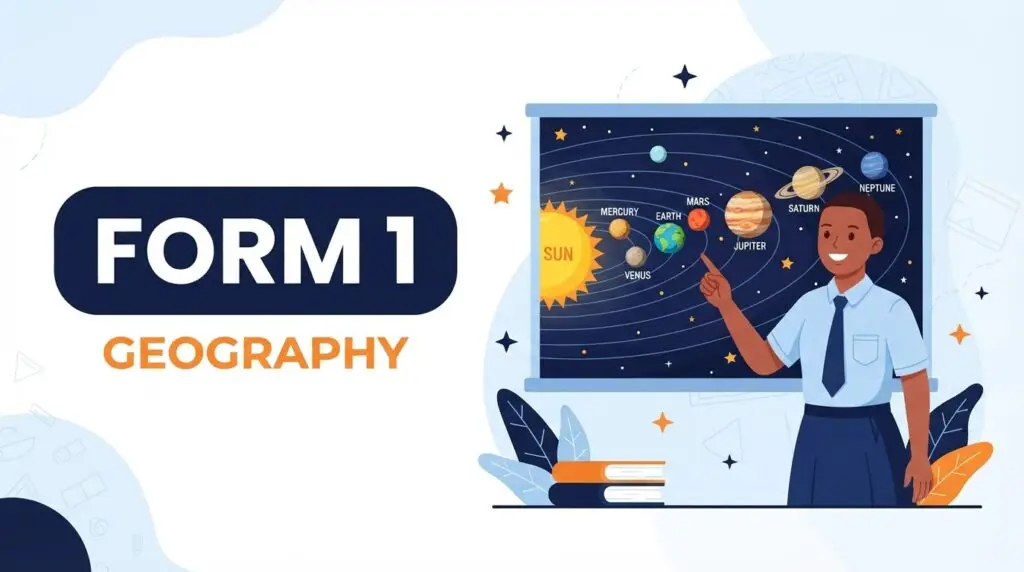
These Form One Geography Solar System notes explain one of the first big topics you meet in secondary school Geography. You will learn what the solar system is, the features of the Sun and the eight planets, how the Earth moves, why we have day and night and seasons, how the Moon causes eclipses, and how to calculate time using longitude. The notes end with five review questions and answers so you can test yourself during the holiday.
Contents
For the other Form One topics, such as weather, climate and map work, see the full Form One Geography Notes (All Topics).
What Is the Solar System?
The solar system is made up of the Sun and all the bodies that move around it because of its gravity. These bodies include planets, their moons (natural satellites), dwarf planets such as Pluto, asteroids, comets and meteoroids. The solar system is only a tiny part of a much larger group of stars called a galaxy; our galaxy is the Milky Way. All galaxies together, with everything in space, form the universe.
Key Terms
- Star: a huge ball of hot gases that produces its own heat and light. The Sun is a star.
- Planet: a large body that moves around the Sun in a fixed path and shines by reflecting sunlight.
- Orbit: the curved path followed by a planet around the Sun, or by a moon around a planet.
- Satellite: a body that revolves around a planet. The Moon is Earth’s natural satellite; artificial satellites are made by people.
- Asteroids: small rocky bodies, most of which orbit the Sun between Mars and Jupiter (the asteroid belt).
- Comet: a body of ice and dust that develops a glowing tail when it comes near the Sun.
- Meteor: a piece of rock that burns up as it enters Earth’s atmosphere (“shooting star”); if part of it reaches the ground it is called a meteorite.
The Sun
The Sun is at the centre of the solar system. It is a star made mostly of hydrogen and helium gases, and it produces energy by nuclear reactions in its core. The Sun is very important for life on Earth because it:
- provides light and heat that make life possible;
- supplies energy for photosynthesis in green plants;
- drives the water cycle by causing evaporation;
- causes differences in air pressure that produce winds;
- holds all the planets in their orbits through its gravitational pull;
- is a source of solar energy used for electricity and drying crops.
The Eight Planets of the Solar System
There are eight planets. In 2006 the International Astronomical Union reclassified Pluto as a dwarf planet, so older books that list nine planets are out of date. A simple way to remember the order from the Sun is the sentence: My Very Educated Mother Just Served Us Noodles (Mercury, Venus, Earth, Mars, Jupiter, Saturn, Uranus, Neptune).
| Position | Planet | Group | Notable feature |
|---|---|---|---|
| 1 | Mercury | Inner (terrestrial) | Smallest planet and closest to the Sun |
| 2 | Venus | Inner (terrestrial) | Hottest planet because its thick atmosphere traps heat |
| 3 | Earth | Inner (terrestrial) | Only planet known to support life; has liquid water |
| 4 | Mars | Inner (terrestrial) | Called the “red planet” because of iron oxide dust |
| 5 | Jupiter | Outer (gas giant) | Largest planet in the solar system |
| 6 | Saturn | Outer (gas giant) | Famous for its bright system of rings |
| 7 | Uranus | Outer (ice giant) | Rotates while tilted almost on its side |
| 8 | Neptune | Outer (ice giant) | Farthest planet from the Sun; very cold and windy |
Inner planets are small, rocky and dense, with few or no moons. Outer planets are very large, made mostly of gases and ice, have rings and many moons, and take much longer to go around the Sun.
The Earth: Shape and Evidence
The Earth is nearly spherical (slightly flattened at the poles). Evidence that the Earth is round includes:
- Photographs taken from space show a round Earth.
- During a lunar eclipse, the Earth’s shadow on the Moon is always curved.
- When a ship sails towards the shore, its mast appears first and the hull appears later.
- People have travelled round the world in one direction and returned to the starting point (circumnavigation).
- The Sun rises earlier in places to the east than in places to the west.
Movements of the Earth
1. Rotation
Rotation is the spinning of the Earth on its own axis, an imaginary line through the North and South Poles. The Earth rotates from west to east and completes one rotation in about 24 hours. Effects of rotation:
- causes day and night, because only half of the Earth faces the Sun at any time;
- causes the apparent movement of the Sun from east to west across the sky;
- causes time differences between places on different longitudes;
- deflects winds and ocean currents (to the right in the Northern Hemisphere and to the left in the Southern Hemisphere);
- together with the Moon’s pull, contributes to the daily rise and fall of tides.
2. Revolution
Revolution is the movement of the Earth around the Sun in its orbit. One revolution takes about 365¼ days. Because of the extra quarter day, one day is added to February every four years, giving a leap year of 366 days. The Earth’s axis is tilted at about 23½° from the vertical, and this tilt, combined with revolution, produces the following effects:
- seasons (summer, autumn, winter and spring) in middle and high latitudes;
- changes in the length of day and night during the year;
- changes in the position of the midday Sun in the sky;
- the equinoxes (around 21 March and 23 September), when the midday Sun is overhead at the Equator and day and night are about equal everywhere;
- the solstices (around 21 June, Sun overhead at the Tropic of Cancer, and around 22 December, Sun overhead at the Tropic of Capricorn).
The Moon and Eclipses
The Moon is Earth’s only natural satellite. It does not produce its own light; it reflects sunlight. As the Moon moves around the Earth, we see different amounts of its lit side, giving the phases of the Moon (new moon, crescent, half moon, gibbous and full moon). One full cycle of phases takes about 29½ days.
- Solar eclipse: occurs when the Moon passes between the Sun and the Earth, blocking sunlight from reaching part of the Earth. It can only happen at new moon.
- Lunar eclipse: occurs when the Earth comes between the Sun and the Moon, so the Earth’s shadow falls on the Moon. It can only happen at full moon.
Diagram description: draw the Sun on the left, the Earth on the right and the Moon in between for a solar eclipse; for a lunar eclipse, place the Earth in the middle with its cone-shaped shadow falling on the Moon.
Calculating Local Time Using Longitude
The Earth turns through 360° in 24 hours, so it turns 15° in one hour, or 1° in 4 minutes. Places to the east of a given place are ahead in time; places to the west are behind.
Worked example: When it is 12:00 noon at Greenwich (0°), what is the local time at a town on longitude 39°E? Difference = 39° × 4 minutes = 156 minutes = 2 hours 36 minutes. The town is east, so add: local time = 2:36 p.m. (Note that countries use standard time zones for daily life; Tanzania uses East Africa Time, three hours ahead of Greenwich.)
Summary of the Topic
- The solar system = Sun + eight planets + moons, dwarf planets, asteroids, comets and meteoroids.
- Order of planets: Mercury, Venus, Earth, Mars, Jupiter, Saturn, Uranus, Neptune.
- Rotation (about 24 hours) gives day and night and time differences.
- Revolution (about 365¼ days) plus the tilted axis gives seasons, equinoxes and solstices.
- Solar eclipse: Moon between Sun and Earth. Lunar eclipse: Earth between Sun and Moon.
- 1° of longitude = 4 minutes of time; east is ahead, west is behind.
Review Questions with Answers
- Why is Venus hotter than Mercury even though Mercury is closer to the Sun? Venus has a very thick atmosphere of carbon dioxide that traps heat (a strong greenhouse effect), while Mercury has almost no atmosphere to hold heat.
- Give two differences between rotation and revolution. Rotation is spinning on the axis while revolution is moving around the Sun; rotation takes about 24 hours while revolution takes about 365¼ days.
- Why does a leap year occur every four years? Because one revolution takes about 365¼ days, the four extra quarter days add up to one full day, which is added to February.
- It is 9:00 a.m. at Greenwich. What is the local time at a place on 30°W? 30 × 4 = 120 minutes = 2 hours; the place is west, so subtract: 7:00 a.m.
- State the position of the Sun, Earth and Moon during a lunar eclipse. The Earth is between the Sun and the Moon, so the Earth’s shadow falls on the Moon.
Frequently Asked Questions
How many planets are in the solar system?
There are eight planets. Pluto was reclassified as a dwarf planet in 2006, so it is no longer counted among the main planets.
Which is the largest planet in the solar system?
Jupiter is the largest planet. It is a gas giant and is much bigger than all the inner planets combined.
What is the easiest way to remember the order of the planets?
Use a memory sentence such as “My Very Educated Mother Just Served Us Noodles”, where each first letter stands for a planet in order from the Sun.
Final Word
The solar system topic is full of easy marks once you understand the movements of the Earth and practise time calculations. Read these Form One Geography Solar System notes twice, draw the eclipse diagrams yourself, and try the review questions without looking at the answers first.