These form five logic notes cover the Logic topic in Advanced Mathematics step by step: propositions, connectives, truth tables, logical equivalence, the laws of the algebra of propositions, valid arguments and switching circuits. Every idea comes with a worked example, and the notes end with five review questions and answers you can use to test yourself.
Contents
Propositions and Connectives
A proposition (statement) is a sentence that is either true (T) or false (F), but not both. “Dodoma is the capital city of Tanzania” is a true proposition. “7 is an even number” is a false proposition. Commands, questions and open sentences such as “x + 2 = 5” are not propositions, because they have no fixed truth value.
Simple propositions are joined by connectives to form compound propositions. We usually use the letters p, q and r for simple propositions.
| Connective | Symbol | Read as | True when |
|---|---|---|---|
| Negation | ~p | not p | p is false |
| Conjunction | p ∧ q | p and q | both are true |
| Disjunction | p ∨ q | p or q | at least one is true |
| Conditional | p → q | if p then q | always, except when p is true and q is false |
| Biconditional | p ↔ q | p if and only if q | p and q have the same truth value |
Truth Tables in Form Five Logic Notes
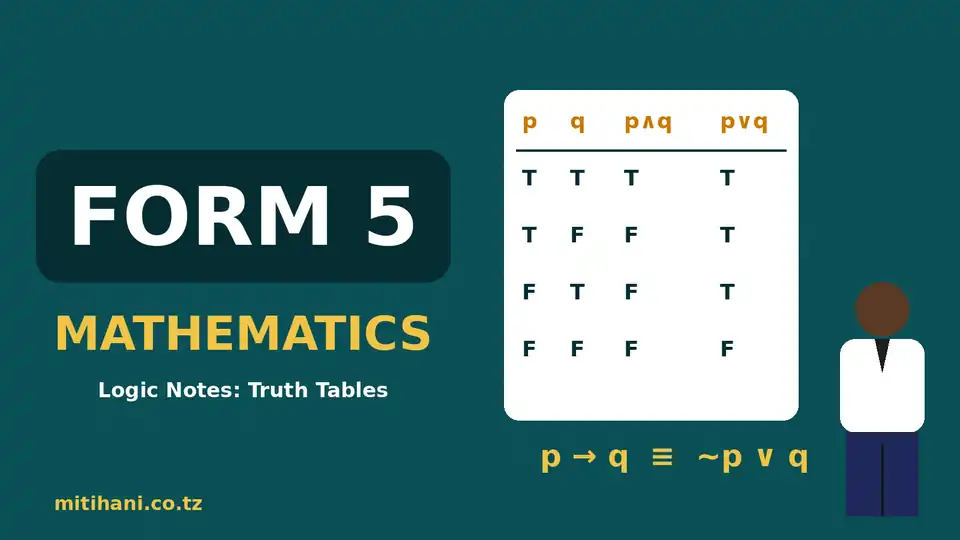
A truth table lists every possible combination of truth values. With n simple propositions there are 2n rows: 4 rows for p and q, and 8 rows for p, q and r. Always list the values in a fixed pattern so you do not miss a case.
| p | q | p ∧ q | p ∨ q | p → q | p ↔ q |
|---|---|---|---|---|---|
| T | T | T | T | T | T |
| T | F | F | T | F | F |
| F | T | F | T | T | F |
| F | F | F | F | T | T |
Tautology, Contradiction and Contingency
- A tautology is always true, for example p ∨ ~p.
- A contradiction is always false, for example p ∧ ~p.
- A contingency is true in some rows and false in others, for example p → q.
Logical Equivalence and Related Conditionals
Two compound propositions are logically equivalent (≡) when they have identical truth values in every row. A useful example is p → q ≡ ~p ∨ q. Check it yourself: ~p ∨ q is false only when p is true and q is false, exactly like p → q.
From a conditional p → q we form three related statements:
- Converse: q → p
- Inverse: ~p → ~q
- Contrapositive: ~q → ~p
The contrapositive is always equivalent to the original statement, and the converse is equivalent to the inverse. Example: “If it rains, the ground is wet.” Contrapositive: “If the ground is not wet, it did not rain.” Converse: “If the ground is wet, it rained”, which need not be true because someone may have watered the ground.
Laws of the Algebra of Propositions
These laws let you simplify compound statements without drawing long truth tables. T stands for a tautology and F for a contradiction.
| Law | Form |
|---|---|
| Idempotent | p ∨ p ≡ p; p ∧ p ≡ p |
| Commutative | p ∨ q ≡ q ∨ p; p ∧ q ≡ q ∧ p |
| Associative | (p ∨ q) ∨ r ≡ p ∨ (q ∨ r) |
| Distributive | p ∧ (q ∨ r) ≡ (p ∧ q) ∨ (p ∧ r) |
| Identity | p ∨ F ≡ p; p ∧ T ≡ p |
| Complement | p ∨ ~p ≡ T; p ∧ ~p ≡ F |
| Double negation | ~(~p) ≡ p |
| De Morgan’s laws | ~(p ∧ q) ≡ ~p ∨ ~q; ~(p ∨ q) ≡ ~p ∧ ~q |
| Absorption | p ∨ (p ∧ q) ≡ p; p ∧ (p ∨ q) ≡ p |
Worked example: Simplify (p ∧ q) ∨ (p ∧ ~q). By the distributive law this is p ∧ (q ∨ ~q). By the complement law q ∨ ~q ≡ T, so the expression becomes p ∧ T, which by the identity law is simply p.
Validity of Arguments
An argument has premises and a conclusion. It is valid if the conclusion is true whenever all the premises are true. One method is to show that (premise 1 ∧ premise 2 ∧ …) → conclusion is a tautology. Another quick method is to search for a row where all premises are true but the conclusion is false; if such a row exists, the argument is invalid.
- Modus ponens (valid): p → q, p; therefore q.
- Modus tollens (valid): p → q, ~q; therefore ~p.
- Affirming the consequent (invalid): p → q, q; therefore p. In the row p = F, q = T, both premises are true but the conclusion is false.
Logic and Electrical Networks
Switches can model propositions: a closed switch is T and an open switch is F. Picture two switches p and q placed one after the other on the same wire. Current flows only when both are closed, so switches in series represent p ∧ q. Now picture the two switches on separate branches between the same two points. Current flows when either is closed, so switches in parallel represent p ∨ q.
For example, a circuit with p and q in series, and that pair connected in parallel with a third switch r, is described by (p ∧ q) ∨ r. Simplifying the expression with the laws above gives a simpler circuit that does the same job. This kind of careful, rule-based reasoning also helps in other Form Five subjects such as our Form Five Physics Measurement Notes.
Summary of Key Points
- A proposition has exactly one truth value.
- A truth table with n variables has 2n rows.
- p → q is false only when p is true and q is false.
- A statement is equivalent to its contrapositive.
- Series switches mean “and”; parallel switches mean “or”.
Review Questions with Answers
1. Which of these are propositions? (a) “Dar es Salaam is in Tanzania.” (b) “Close the window.” (c) “x + 3 = 10.”
Answer: Only (a). Sentence (b) is a command and (c) is an open sentence whose truth depends on x.
2. Construct the truth table of (p → q) ∧ (q → p) and compare it with p ↔ q.
Answer: For the rows TT, TF, FT, FF the values of p → q are T, F, T, T and of q → p are T, T, F, T. Their conjunction is T, F, F, T, which matches p ↔ q, so the two are equivalent.
3. Write the contrapositive of “If a number is even, then it is divisible by 2.”
Answer: “If a number is not divisible by 2, then it is not even.”
4. Test the validity of: p → q, q → r; therefore p → r.
Answer: Valid. If p → r were false, p would be true and r false. Then q → r being true forces q to be false, which makes p → q false, contradicting the premises. This form is called the hypothetical syllogism.
5. Simplify ~(p ∨ ~q).
Answer: By De Morgan’s law, ~(p ∨ ~q) ≡ ~p ∧ ~(~q), and by double negation this is ~p ∧ q.
Frequently Asked Questions
Why is p → q true when p is false?
A conditional only makes a promise about what happens when p is true. When p is false, the promise is not broken, so the statement is treated as true.
Should I use truth tables or the laws of algebra to prove equivalence?
Use whichever the question asks for. If it does not say, laws are faster for long expressions, while truth tables are safer for short ones.
How can I revise Logic during the holiday?
Practise one truth table and one simplification every day. You can combine this with the holiday questions in the Minaki Form Five Holiday Package.
Final Word
Logic is a scoring topic once you master truth tables and the main laws. Keep these form five logic notes close, practise the review questions until you can answer them without looking, and you will handle any Logic question with confidence.